SCADA Defined
In the water and wastewater industry, SCADA systems monitor pump stations, water storage tanks, wells, treatment plants, and collection system infrastructure. They collect data from sensors in the field, transmit that data to a central platform, and provide operators with real-time visibility into what is happening across their entire system.
SCADA enables two fundamental capabilities: supervisory control (the ability to remotely operate equipment like pumps and valves) and data acquisition (the ability to collect, store, and analyze operational data from field equipment). Together, these capabilities transform how utilities manage their infrastructure—replacing manual inspections and reactive responses with automated monitoring and data-driven decision-making.
The ability to remotely operate equipment like pumps and valves.
The ability to collect, store, and analyze operational data from field equipment.
How a SCADA System Works
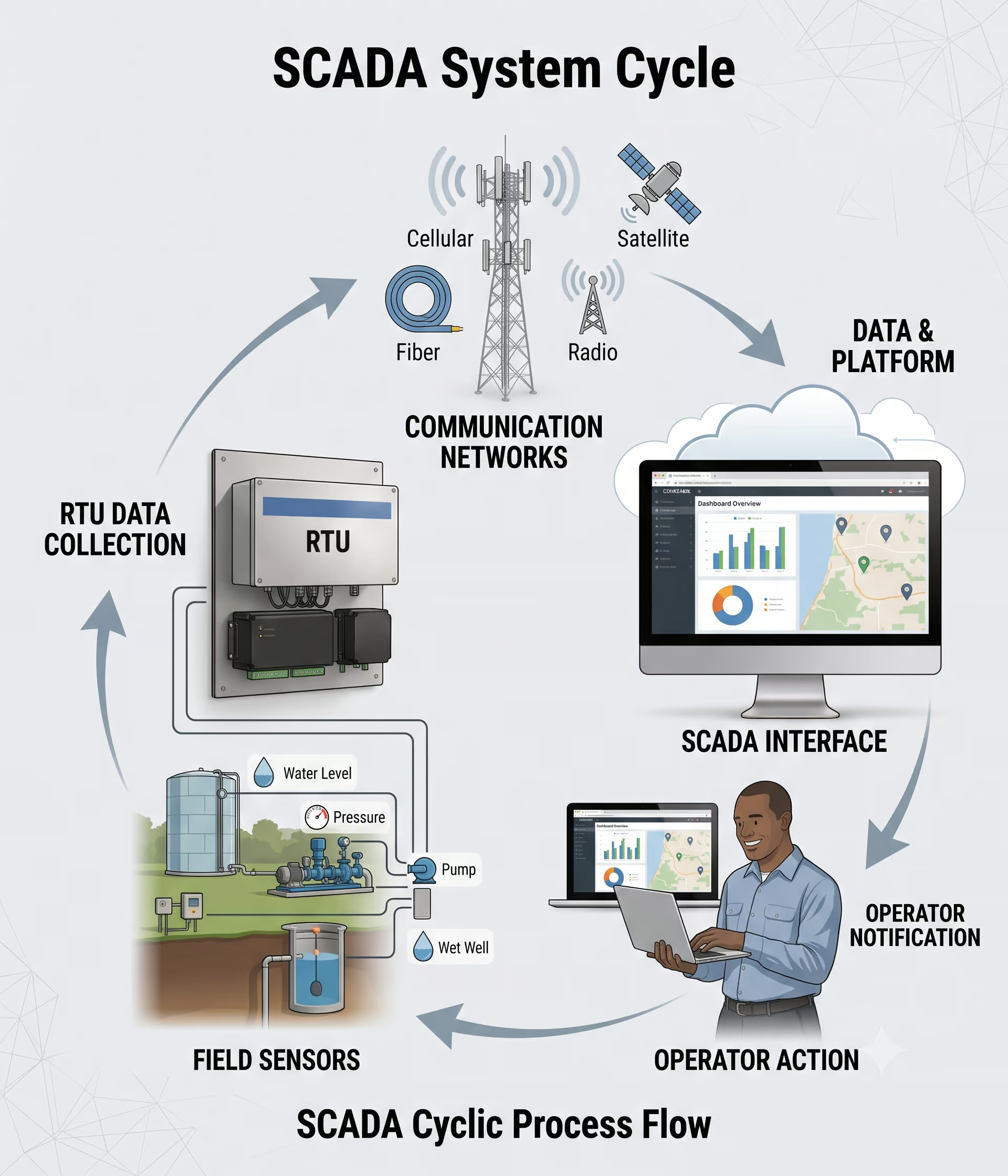
A SCADA system consists of four core layers that work together to deliver monitoring and control:
When a sensor detects a change—for example, a rising water level in a lift station wet well—the RTU captures that reading, timestamps it, and transmits it to the central platform. The platform processes the data, updates the operator’s dashboard, and checks the reading against configured alarm thresholds. If the level exceeds the threshold, the system dispatches an alarm notification to the on-call operator.
Field Devices and Sensors
Physical instruments installed at remote sites that measure conditions like water level, pressure, flow rate, pump status, and power availability. These sensors convert physical measurements into electrical signals.
Remote Terminal Units (RTUs)
Ruggedized electronic devices installed at each field site that collect data from sensors, execute local control logic, and transmit data to the central system. RTUs are the bridge between the physical world and the software platform.
Communication Network
The data pathway between RTUs and the central system. Communication methods include cellular networks, private radio, satellite, fiber, and internet connections. Modern SCADA systems increasingly favor cellular communication for its reliability, coverage, and low maintenance requirements.
Central Platform (Software and HMI)
The software application where operators view data, manage alarms, generate reports, and issue control commands. The Human Machine Interface (HMI) presents data in visual formats like maps, dashboards, graphs, and trending displays.
Types of SCADA Systems
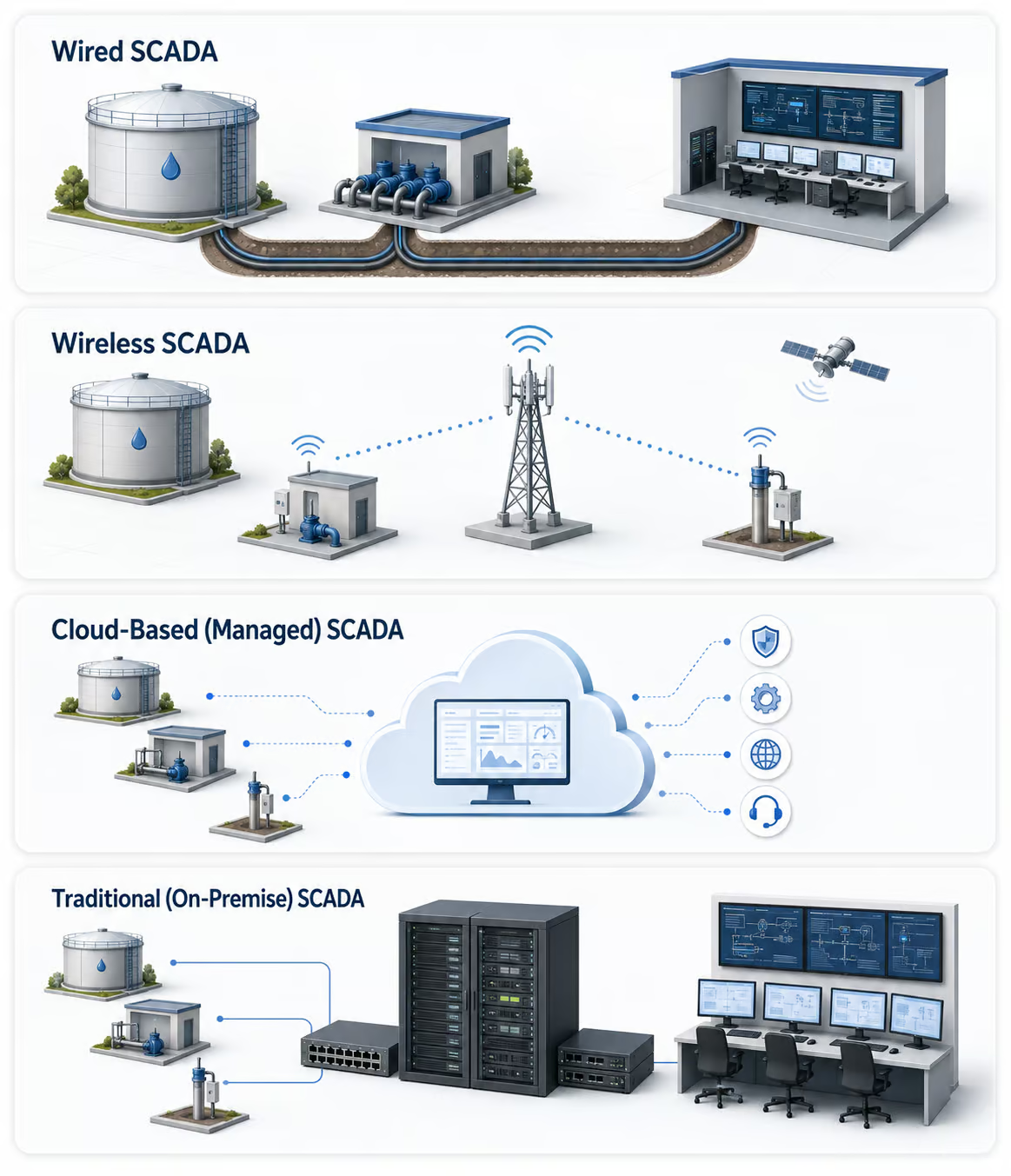
SCADA systems can be categorized by their communication method and hosting model:
Wired SCADA
Uses physical connections like Ethernet, fiber optic cable, or telephone lines between field sites and the central system. Wired systems offer high bandwidth but require significant infrastructure investment and are vulnerable to physical damage.
Wireless SCADA
Uses radio networks (licensed or unlicensed), cellular networks, or satellite communication. Wireless SCADA eliminates the need for physical cabling between sites and is generally more cost-effective for geographically distributed systems like water and wastewater utilities.
Cloud-Based (Managed) SCADA
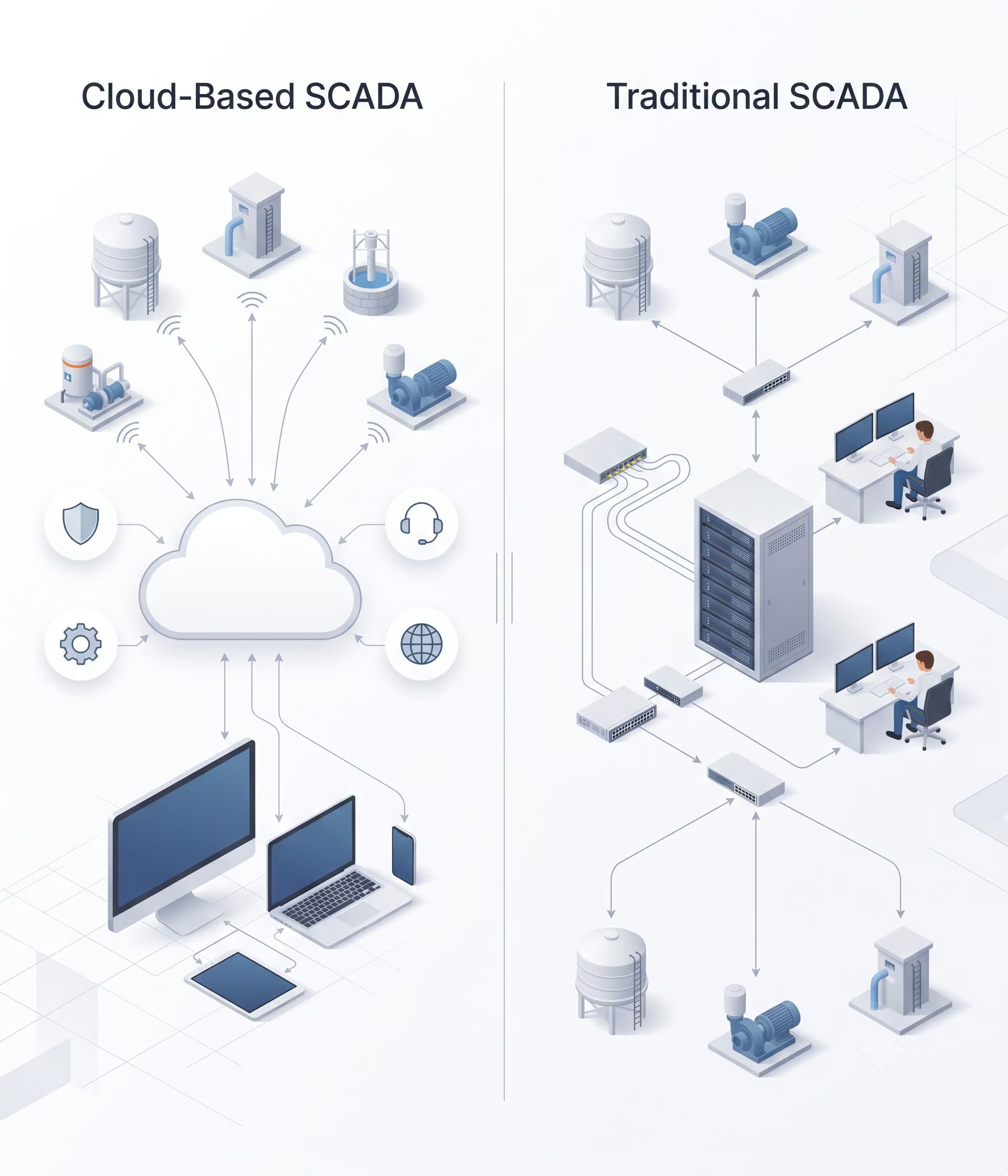
A newer model where the SCADA software platform is hosted in the cloud rather than on local servers. Cloud SCADA eliminates the need for on-premise IT infrastructure, provides automatic software updates, and offers access from any internet-connected device. Managed SCADA takes this further by bundling software, communication, hosting, and support into a single subscription service built around purpose-built field hardware.
Traditional (On-Premise) SCADA
The conventional approach where utilities purchase hardware, license software, build communication networks, and host the system on their own servers. This model offers maximum customization but requires significant capital investment, in-house technical expertise, and ongoing maintenance.
SCADA for Water and Wastewater Utilities
Water and wastewater utilities are among the largest users of SCADA technology. The distributed nature of water infrastructure—with pump stations, tanks, wells, and treatment facilities spread across a service area—makes remote monitoring essential for operational efficiency and regulatory compliance.
Common SCADA applications in the water sector include lift station monitoring to prevent sewer overflows, water tank level monitoring with automated pump control, well field management and aquifer protection, distribution system pressure and flow monitoring, treatment plant process control, stormwater and rainfall monitoring for flood prevention and I&I studies, and CSO/SSO event detection and compliance reporting.
For many small to mid-size utilities, managed SCADA has become the preferred approach because it delivers enterprise-grade monitoring without requiring the capital investment, technical staff, or IT infrastructure that traditional SCADA demands.
See every application Mission monitors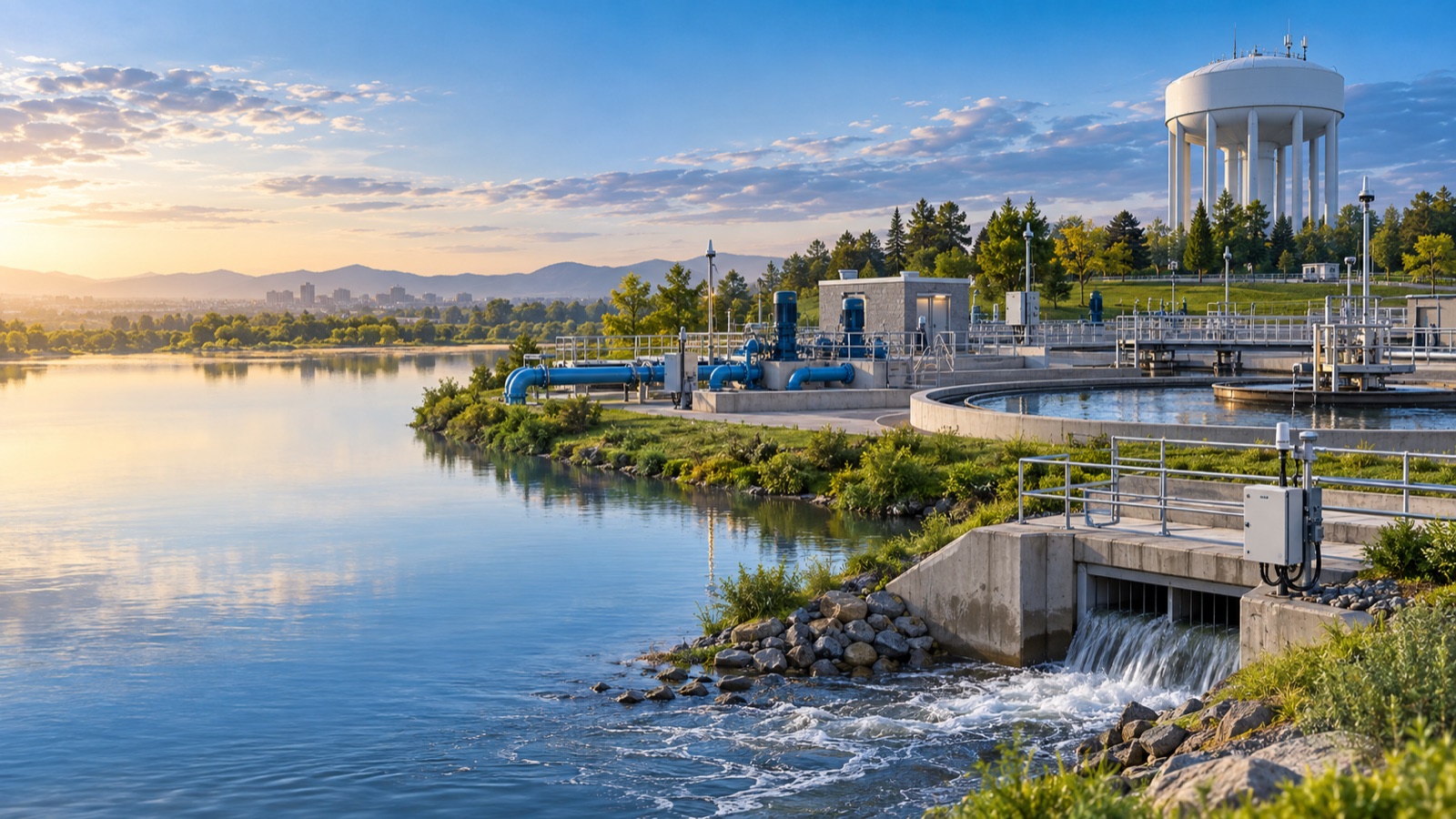
Cloud SCADA vs. Traditional SCADA: How to Choose
The choice between cloud-based managed SCADA and traditional on-premise SCADA depends on the utility’s size, technical resources, and monitoring requirements.
Cloud / managed SCADA is typically the best fit for utilities that…
- need reliable monitoring across distributed field assets
- want predictable operating costs without large capital expenditures
- have limited or no in-house IT and SCADA programming staff
- prefer to outsource system maintenance, security, and updates
- need to deploy quickly without lengthy engineering and construction timelines
Traditional SCADA may be appropriate for…
- large utilities with dedicated SCADA engineering teams
- facilities requiring high-speed process control with millisecond response times (like treatment plant automation)
- organizations that require full ownership and customization of every system component
Many utilities adopt a hybrid approach, using managed SCADA for their distributed collection and distribution system assets while maintaining traditional SCADA for plant-level process control. OPC-UA integration allows both systems to share data seamlessly.
Getting Started with SCADA
If your utility is evaluating SCADA options, Mission Communications can help you assess your monitoring needs and determine whether managed SCADA is the right fit. With more than 25 years of experience and over 4,000 utility customers, Mission has the expertise to guide you from evaluation through deployment. Call 877.993.1911 or click below to request a demo and see managed SCADA in action.